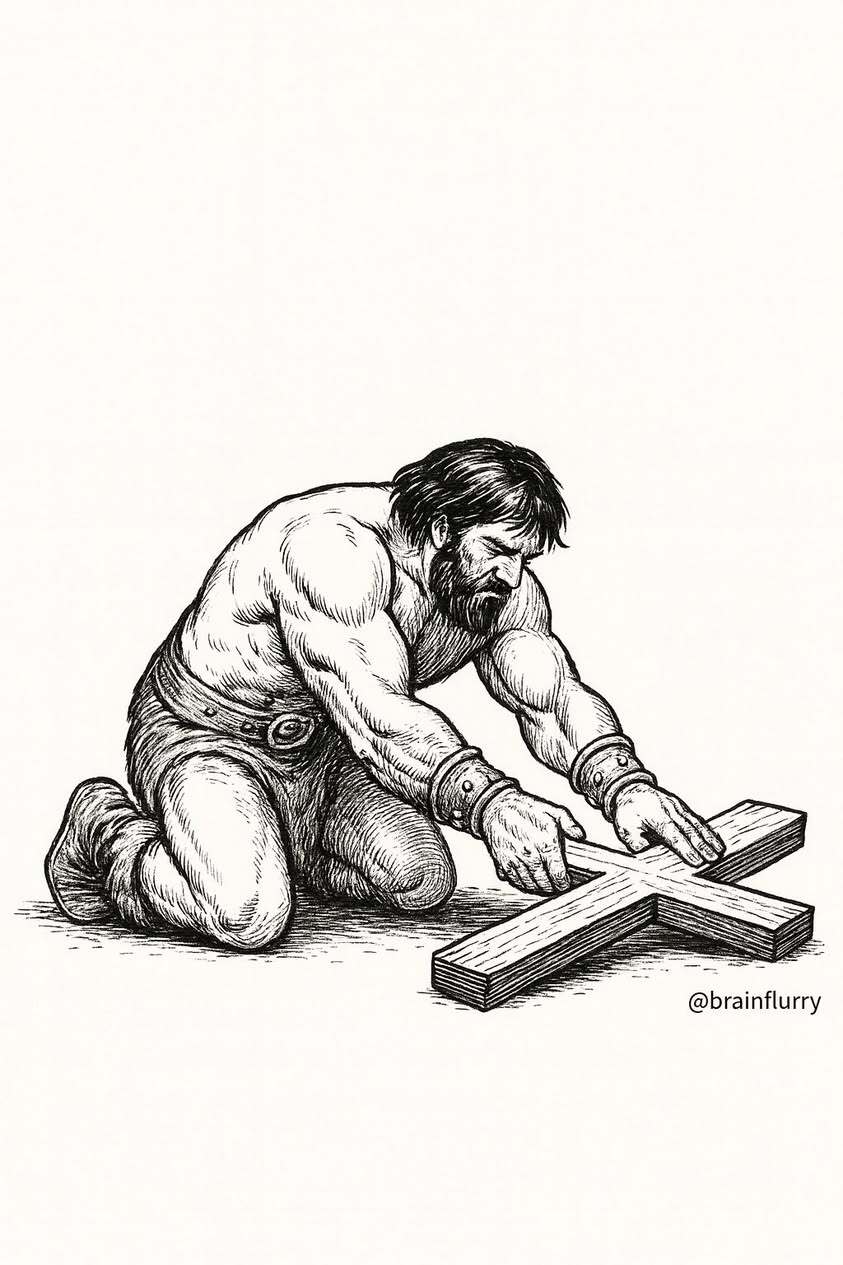
Meet God In The Fire

Paul Luckett | Brainflurry.com - Meet God In The Fire

Is God not real to you?

Does God seem more like a lofty concept than a real person you can walk with through life?

Do you want to see God?

Meet Him in the fire.

“Then King Nebuchadnezzar was astonished; and he rose in haste and spoke, saying to his counselors, ‘Did we not cast three men bound into the midst of the fire?’ They answered and said to the king, ‘True, O king.’ ‘Look!’ he answered, ‘I see four men loose, walking in the midst of the fire; and they are not hurt, and the form of the fourth is like the Son of God.’
– Daniel 3:24-25

Fire brings God’s shape into view when, in humility, we desire Him more than we desire to escape the flames of adversity of this life through safety and comfort elsewhere.

When we abide in His love through obedience, stand firm on the hope of His appearing, and do not abandon the eternal for the temporary, He appears.

I don’t like hardship, but it is often in the midst of difficulty, at the edge of our ability—where we don’t know what, why, when, or how—that causes us to question and cry out in faith, and there He meets us.

“My brethren, count it all joy when you fall into various trials, knowing that the testing of your faith produces patience. But let patience have its perfect work, that you may be perfect and complete, lacking nothing. If any of you lacks wisdom, let him ask of God, who gives to all liberally and without reproach, and it will be given to him.”
– James 1:2-5

It is there, in the fire, where it gets real, where His presence is often most keenly felt, where He grants us wisdom and a grace to go on that we did not previously have. What is more real than that?

It is in the fire that God is a very real comfort for me. It’s more than head knowledge; it’s a presence like being braced by an arm to keep me from falling.

In my own words, I echo the words of the Psalmist, David, in Psalm 23:4,

“As I walk through the seemingly existential threats of this life,
You protect me from the death of separation from You,
You keep me in The Way of life.
‘You are with me;
Your rod and Your staff, they comfort me'”

This is the God I’ve met—and the One you can meet too—in the fire.

Who Can I Run To?

Paul Luckett | Brainflurry.com - Who Can I Run To?

Carefully tucked away in one of the synthetic leather CD cases in our attic is a song by the group Xscape that posed a profound question: “Who can I run to?”

I find myself asking that question today.

Because I’m sad.

It was an emotionally tough day. On my way out of the office, I passed a bucket of candy and I reeeally wanted to run to some chocolate.

But in that moment the Holy Spirit whispered to me that I am welcome to anything I can enjoy in God, but what I cannot do is seek something from anyone or anything else—that’s idolatry.

Consider 1 Corinthians 6:12,
“All things are lawful for me, but all things are not helpful.
All things are lawful for me, but I will not be brought under the power of any.”

Whatever my heart is set on—in other words, whatever my heart desires—is where my heart is. If it is set on worldly things, it leads to death (overeating, futile attempts at comfort through other profitless pursuits, a downward spiral of disappointment, etc.); but if it is set on the Spirit, it leads to life and peace (Romans 8:6).

I know this from painful experience.

So, who can I run to?

I chose (this time, at least) to deny myself and refused to allow another to comfort me.

I have a Comforter (John 14:16).

I cry out and run to Him.

I will wait faithfully on the Lover of my soul.

Broken With Purpose

Paul Luckett | Brainflurry.com - Broken With Purpose

Before Christ, I was just broken.

In many ways, I’m still broken.

But now, I’m broken this way with purpose.

Jesus uses my brokenness to heal others of the same brokenness as He heals me.

Hallelujah!

Jesus healed a man born blind so that others could see.

“And His disciples asked Him, saying, ’Rabbi, who sinned, this man or his parents, that he was born blind?’

Jesus answered, ‘Neither this man nor his parents sinned, but that the works of God should be revealed in him.’”
— John 9:2-3

The key is not hiding my brokenness.

“Then some of the Pharisees who were with Him heard these words, and said to Him, ’Are we blind also?’

Jesus said to them, ‘If you were blind, you would have no sin; but now you say, “We see.” Therefore your sin remains.’”
— John 9:40-41

But we must confess our sins to one another before God that we may be healed.

“Confess your trespasses to one another, and pray for one another, that you may be healed. The effective, fervent prayer of a righteous man avails much.”
— James 5:16

Lord, if you show me, Imma tell it. Like the woman at the well, I will run and tell of the One who told me everything that I ever did, so they, too, can drink of this living water that You gave me and be healed.

Everything I am, Lord, including my brokenness, is for Your use.

I love You.

Amen.

I Will Not Let Fear Stop Me

Paul Luckett | Brainflurry.com - I Will Not Let Fear Stop Me

You know what?

I’m going to stop trying to anticipate when someone might hurt me.

I’m not going to let fear of what someone might do stop me from doing what is in me to do, and what I am eager to do, which is to love fully without holding back. (2 Timothy 1:7)

If and when you hurt me, I’ll deal with it then.

I can take the hurt.

And I know I CAN because of the power of Christ that is within me—power that allowed Him to take the hurt, power that can even raise the dead. (Hebrews 12:2, Philippians 4:13)

There’s nothing you can do to me that Jesus can’t heal. In fact, all you can do is make me stronger. (Romans 8:37-39)

Here’s how “[His] perfect love casts out [my] fear.” (1 John 4:18)

I will not let fear stop me from enjoying His wonderful love.

#perfectourlove

What Is Sanctification?

Paul Luckett | Brainflurry.com - What Is Sanctification

Sanctification is learning to love God and to hate everything else.

Does this offend you?

Consider Deuteronomy 6:5,

“You shall love the LORD your God with all your heart, with all your soul, and with all your strength.”

And, Luke 14:26,

“If anyone comes to Me and does not hate his father and mother, wife and children, brothers and sisters, yes, and his own life also, he cannot be My disciple.”

My prayer has been to be set free even from a desire for my wife, who is most dear and precious to me.

I want my only desire to be for my wife who is in Christ.

See the difference?

Loving who is begotten by God, including those not yet made manifest, is one and the same as loving God.

“And this commandment we have from Him: that he who loves God must love his brother also.”
— 1 John 4:21

When the affection and desire of my heart is singular, I become “steadfast, immovable, always abounding in the work of the Lord” (1 Corinthians 15:58)

I can then be like Jesus, who hated Simon, but loved Peter, who in one breath calls Him blessed and in the next call Him Satan, because one was in God and the other was without.

Matthew 16:17, after Peter’s confession of faith,

“Jesus answered and said to him, ‘Blessed are you, Simon Bar-Jonah, for flesh and blood has not revealed this to you, but My Father who is in heaven.’”

Matthew 16:23, six verses later,

”But He turned and said to Peter, ‘Get behind Me, Satan! You are an offense to Me, for you are not mindful of the things of God, but the things of men.’”

When the affection and desire of my heart is singular, I become pure (oneness) in heart—a prerequisite to see God.

Learning to love God and to hate everything else is the process of being made holy, set apart and fit for service, which is sanctification.

#sanctification #heartwords

Delighted In God Alone

Paul Luckett | Brainflurry.com - Delighted In God Alone

If I have God and want anything else, I do not see God properly.

“Whom have I in heaven but You?
And there is none upon earth that I desire besides You.”
— Psalm 73:25

God is more than enough—He is exceedingly greater than anything I can desire.

If I have God and want anything else, I do not see God properly.

So, my prayer in this season is,

“Please let me see you, God.

Lord Jesus, I want to see the Father the way You do.

I want to love Him the way You do, so that I may gain the same heart and mind that You have—a heart so full of love for the Father that it needs nothing else.

Help me, Lord Jesus.

Please, Holy Spirit, open my understanding.

In Jesus name I pray.

Amen.

I want to be delighted with God alone.
Please pray for me.

#perfectourlove

How To Experience God

Paul Luckett | Brainflurry.com - How To Experience God

How do we help others who have not yet experienced God relate to a God we cannot touch, taste, see, smell or hear physically?

Ironically, it is by touching, tasting, seeing, smelling and hearing—but spiritually.

“Oh, taste and see that the LORD is good; Blessed is the man who trusts in Him!”
— Psalm 34:8

People are spiritual.

Have you ever encountered a bitter person?

In many cases you don’t even need any physical indication that they’re bitter; it’s a spirit you can “sense” that leaves a bad taste in your mouth.

I believe we are all built with the capability—the spiritual receptors to perceive God.

Could this be what the Apostle Paul is referring to in Romans 1:19?

“because what may be known of God is manifest in them, for God has shown it to them.”
— Romans 1:19

But our nerve endings are dead, numbed by sin, their sensitivity suppressed under layers of the filth of this world—what we’ve come to believe and accept as truth rather than The Truth, the ways we’ve come to operate rather than The Way and the value systems that we’re governed by rather than the Kingdom of God—ways that are own ways and government that is lawlessness.

The condition is referred to spiritually as “hardness of the heart”, a condition that progresses to a point that the Apostle Paul refers to in Ephesians 4:19 as “being past feeling”.

And nothing accelerates this condition more than fake church and false religion (2 Timothy 3:1-5). Jesus said to Pharisees who claimed to “see”, “If you were blind, you would have no sin; but now you say, ‘We see.’ Therefore your sin remains.” (John 9:41)

The degree of the hardness of the heart is a measure of how much territory Satan controls in our heart. Said another way, the degree of the hardness of our hearts is a matter of how much we believe Satan—which is anything other than God, and it is a matter of how much we’re governed by anything that is not the Kingdom of God—which is anything other than Love.

And it is this hardness of the heart that prevents us from perceiving and experiencing God.

The remedy is believing God, being washed by His Word.

“So then faith comes by hearing, and hearing by the word of God.”
— Romans 10:17

But God, even in our deadness, sent The Word to us that we might be made alive, that we may know Him and be made sensitive to His presence.

“God, who at various times and in various ways spoke in time past to the fathers by the prophets, has in these last days spoken to us by His Son, whom He has appointed heir of all things, through whom also He made the worlds;”
— Hebrews 1:1-2

“For we do not preach ourselves, but Christ Jesus the Lord, and ourselves your bondservants for Jesus’ sake.

For it is the God who commanded light to shine out of darkness, who has shone in our hearts to give the light of the knowledge of the glory of God in the face of Jesus Christ.”
— 2 Corinthians 4:5-6

”And a voice came out of the cloud, saying, ‘This is My beloved Son. Hear Him!’”
— Luke 9:35

Do you want to experience God? Then, do not harden your heart.

Humbly and consistently expose yourself to the Word, crying out to the Holy Spirit for illumination.

A wonder I regularly observe is people who close the doors, shutter the windows—barricading themselves in Satan’s house, and then ask, “Where is God?”

I was one of them.

But, God.

Thanks and glory be to God that He came for me, that He broke through, that “God commanded light to shine out of darkness”, and has shone in my heart to give the light of the knowledge of the glory of God in the face of Jesus Christ. (2 Corinthians 4:5-6)

Hallelujah.

He’s been coming for you. It is why Christ came.

He’s coming for you right now. It is why I preach Christ daily, to make God known to you.

“Therefore, as the Holy Spirit says:

‘Today, if you will hear His voice,

Do not harden your hearts as in the rebellion,

In the day of trial in the wilderness…’”
— Hebrews 3:7-8

Do not harden your heart.

Today, I am challenged to identify and abandon indulgences that dull my senses and to confront and war against demonic occupation in my heart—the obstruction of lies, the cares of this world, the deceitfulness of riches, and the desire for everything besides God that makes it so I can’t hear and experience Him (Mark 4:19).

I count all things loss that I may know Him (Philippians 3:8-10).

As you read this, do you taste that?

It is the residue that mists up from the implanted Word in my heart that is living and powerful, residue that collects on the heart of believers like dew—manna that is sweet to the taste, that provides nourishment, that manifests in a form we can share with others, Bread from heaven that is Spirit and Life.

Taste that?

That’s Christ.

This is how we and how we help others experience God.

#tastimony

Grieving In Context

Paul Luckett | Brainflurry.com - Grieving In Context

One of the most striking verses in the Bible is the shortest, “Jesus wept.” (John 11:35)

Think about that.

The God-man who knows the power of God, who knows heaven, –who knows the ultimate outcome, wept at the tomb of Lazarus.

Jesus, as I call it, “grieved in context”. He was fully God and fully man and therefore fully felt the grief of Mary and Martha, and fully felt His own pain over the loss of someone He calls a friend.

Jesus did not gloss over the grief. He did not ignore it. He did not deny it. He did not overlook it.
He wept.

But, what He did next is key. In verse 41, it says, “And Jesus lifted up His eyes and said, ‘Father, I thank You…'”

The confidence that He expresses in the Father is the context that allowed Him (and us) to grieve but not be consumed.

Grieving in context allows us to be fully human while fully having eternal life and enjoying the peace that comes with it.

“… in everything by prayer and supplication, with thanksgiving, let your requests be made known to God; and the peace of God, which surpasses all understanding, will guard your hearts and minds through Christ Jesus.”
—Philippians 4:6-7

Dealing With The Debt Of My Offense

Paul Luckett | Brainflurry.com - Dealing With The Debt Of My Offense

Man, it cuts deep when someone I care about thinks poorly of me, especially because of sin I’ve committed—sin I’m deeply sorry for, that I’ve since confessed and turned away from. Yet, they continue to hold it against me, refusing to let me escape its condemnation, and won’t receive me.

The Apostle Paul, grieved by his former persecution of Christ and His followers, knew a little something about this. God’s word written through his experience guides me.

Though this specific passage is written in the context of warding against boasting in man and thinking more of someone than is warranted (the error of “I am of Paul” or “I am of Apollos”), it is equally effective in warding against thinking less of myself than I should (because I’ve thought about the assessment of others more than is warranted).

I believe Paul, in this passage, has both in view with the intention of helping believers navigate either:

“But with me it is a very small thing that I should be judged by you or by a human court. In fact, I do not even judge myself.

For I know of nothing against myself, yet I am not justified by this; but He who judges me is the Lord.”
— 1 Corinthians 4:3-4

In short, I am the Lord’s.

“It is a very small thing that I should be judged by you”
It matters little whether you think well of me,

“or by a human court.”
or whether you condemn me.

“I do not even judge myself. For I know nothing against myself, yet I am not justified by this”,
It’s not even about what I think of myself or about me finding reasons to feel better about myself,

“but He who judges me is the Lord.”
but at the end of the day, it is about who I serve—the Lord and He has the final say.

I am the Lord’s.

And you know what? My Lord will love me to where I need to be.

“… being confident of this very thing, the He who has begun a good work in you will complete it until the day of Jesus Christ”
— Philippians 1:6

“Now thanks be to God who always leads us in triumph in Christ …”
—2 Corinthians 2:14

I am the Lord’s.

That’s the conclusion concerning me—about who I am, what I’m worth and where I stand.

So, though others may condemn me, in Christ I am free, and though others may reject me, I am accepted in the Beloved.

“There is therefore now no condemnation to those who are in Christ Jesus, who do not walk according to the flesh, but according to the Spirit.”
— Romans 8:1

“to the praise of the glory of His grace, by which He made us accepted in the Beloved.”
— Ephesians 1:6

I am free.

I am free to forgive unforgiveness and love them compassionately because hurt and lingering resentment is the consequence and nature of sin when I’ve offended another.

Jesus warned how unreconciled offense causes this, snowballing into a seemingly insurmountable debt (Matthew 5:23-26).

When I’ve offended another, I don’t get to dictate how or when they should have healed, or when they should release me from the prison of separation and suspicion, and restore me to relationship. This is why we actively seek to avoid sin at all cost, and seek to reconcile it as quickly as possible when it occurs.

Until those I’ve offended release me, I am free to love them, undefined by their unforgiveness.

As my pastor Gregory Jones was fond of saying, they’ve drawn a circle to exclude me, but I’m making a bigger circle to draw them in. I will minister the inexhaustible riches of God’s grace that He has lavished on me toward the debt that they hold against me.

My ultimate hope in doing so is to win a brother or sister in Christ because I am the Lord’s.

#christesteem

What Is Forgiveness?

Paul Luckett | Brainflurry.com - What Is Forgiveness?

Forgiveness is not the same as forgetting.

If I cannot forget how do I forgive?

For the concept of forgiveness to really click, I must understand and accept that everything God provides me is for the Father’s business—good works, which are the glory and administration of God’s Kingdom: executing God’s mission, caring for God’s beloved people, and maintaining God’s great house (Luke 12:42-48).

Forgiveness is an accounting concept.

Imagine you’re a business owner, as we’re all outlets of God’s manifold grace.

The wares of your store are made available on credit.

But, someone takes something without honoring its worth. This results in a loss for you, otherwise known as hurt, and results in a debt for them, also known as an offense or a trespass.

You have a choice to make. You can either shut down their account, so they can no longer do business. Or, you can forgive the debt so they can continue to do business.

The decision usually comes down to what we’re working for and who. What do we want? What are we attempting to accomplish with our store? Are we working for our own personal profit or another’s? What is “profit”, and what does it look like?

The complexion of the matter completely changes when we’re operating from an economy where:

1. It’s the Father’s business (Luke 2:49),
2. We’re already rich (Ephesians 2:4-7, 1 John 4:26),
3. He’s paid it all (Colossians 2:13-14),
4. His endgame is unrivaled glory: 100% market penetration, to be the only name in the game through domination of all rivals and the redemption of all creation (1 Corinthians 15:22-28),
5. My payoff is My Father being pleased (John 8:29, Luke 19:17, Philippians 2:5-11).

In the normal course of business, when someone receives something of value, they reciprocate that value.

However, every so often we encounter someone who takes but has nothing with which to pay. They’re bankrupt and poor.

The Father’s business model accounts for this: grace.

Even in earthly economies, proprietors go into business ready to accept a certain amount of loss. They have a general ledger account dedicated to it called “Bad Debt” which they will write off at the end of each fiscal year.

But God has left us a blank check, constantly making available to us the boundless riches of His love and grace, so that we do not operate from a loss but have an abundance to continue His work (2 Corinthians 9:8).

God’s mandate is save the lost at any cost for His glory (John 3:16, John 15:8). His desire is that all men might be saved, that all would come to His supper, that His house may be full and that they all would commune with God (1 Timothy 2:4, Luke 14:15-24, Revelation 19:9, 22:17).

Profit is a soul delivered from the kingdom of darkness and brought into His house (Colossians 1:13).

“I say to you that likewise there will be more joy in heaven over one sinner who repents than over ninety-nine just persons who need no repentance.”
— Luke 15:7

So when someone takes something without honoring its worth, we have a column in our ledger to account their debt to: God’s ocean and immeasurable wealth of grace.

And, I can forgive.

And, I can continue doing business with them in hopes of heavenly profit.

God’s business strategy was to give it all away anyway to establish brand recognition and ultimately for the purpose of exchanging our dead existence for eternal life where He is made known through us that He may be glorified (Isaiah 11:1-9).

Therefore,
“Freely you have received, freely give”
— Matthew 10:8

Coming full circle to our original question, “If I cannot forget, how do I forgive?”

The answer is proper accounting.

The key to forgiveness is accounting the offense to the proper account, to the account overflowing with the riches of Christ that God had credited to me.

When someone offends me, it hurts and pain can be hard to forget.

So when I remember that hurt, I should let that serve as a reminder to get my books and recall where that debt is accounted to, and I should find next to their account: In Good Standing. PAID by the Father through Jesus Christ.

My greatest hope is that’s how I appear in God’s Book, understanding that when I do not forgive I lose that credit line (Mark 11:25-26, Matthew 18:21-35).

Consider Christ who, on the cross suffering the most egregious offense, in Luke 23:34 says, “Father, forgive them, for they do not know what they do.”

With that He, through forgiveness, extends us grace.

Now Christ entrusts us with His enterprise and charges us:

“Do business until I come.”
— Luke 19:13

#forgiveness #heartwords