Originally posted on Facebook on Sunday, December 28, 2025.
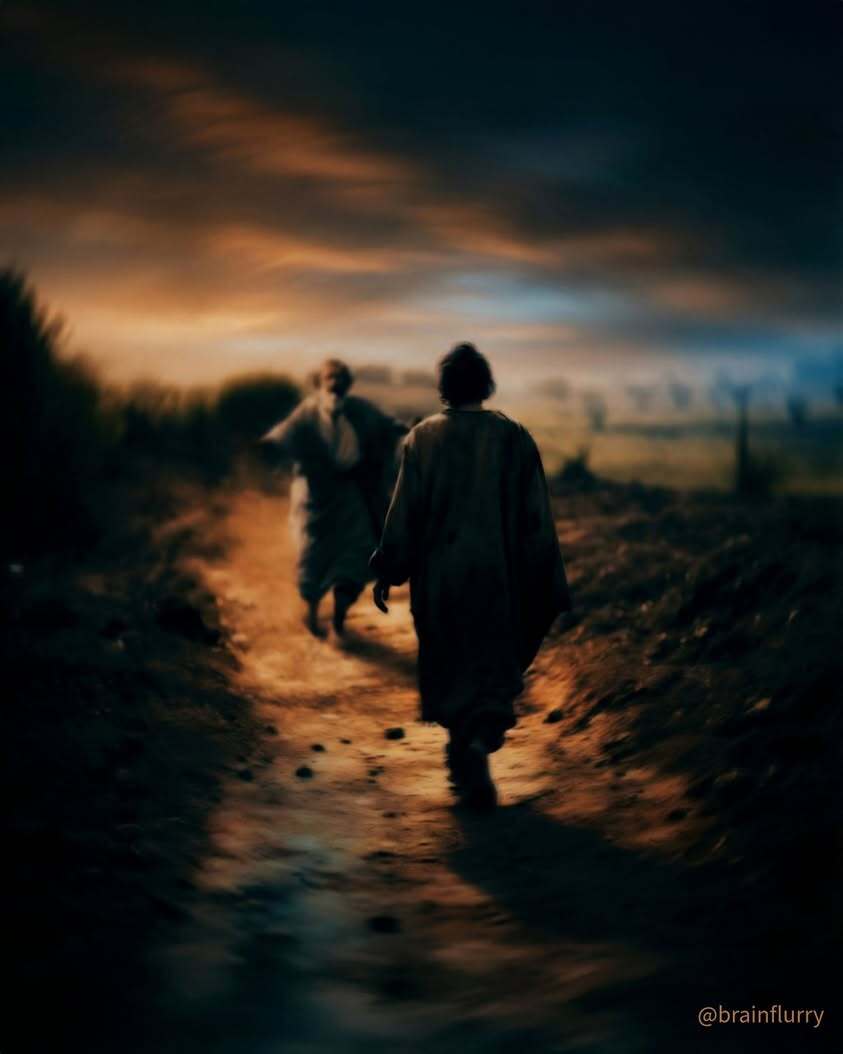
Every so often I find myself in the wilderness, in difficult spots where things are not going the way I would like, and there I'm being asked whether I'd switch up on God (forsaking everything I accept as right and good) to get my way.
The wilderness is inevitable. Everyone is either going into it, in it, or coming out of it. Understanding this helps us to avoid getting stuck there by answering the actual question at hand: "Will I forsake God?"
Never forget that when you overcome such a temptation Satan only departs "until an opportune time". (Luke 4:13)
So, be sober and vigilant, beloved. Because our adversary walks about as a lion, seeking whom he may devour. (1 Peter 5:8)
Originally posted on Facebook on Sunday, December 28, 2025.
An inheritance is something you receive after someone has died. Asking for it beforehand is not only reckless, it suggests, "I wish you were dead".
Before the son even engaged in prodigal living, he was guilty of offense against the father by demanding his inheritance.
However the father did not curse his son out or condemn him, but he allows his son his choice.
Why?
Could it be what the Father did was in hope?
Could it be that in his loving wisdom he looked many steps ahead and did the only thing that would allow his beloved son to truly come home?
What a master class in parenting and love.
It challenges me to expand my view of parenting and correction beyond coercing them to conform but to create the conditions necessary for me to receive them.
This begins with righteousness, love, and mercy at home.
Without righteousness there is no way for the son to recognize, "I have sinned **against heaven** AND before you." (Luke 15:18)
Without love there is no way for the son to recognize that people are treated well and nurtured there, "[Even] my father's hired servants have bread enough and to spare…" (Luke 15:17)
Without mercy there is no way for him to expect to be received, "I will arise and go to my father…" (Luke 15:18)
The father does this not once, but twice. He shepherds another son who is just as astray as his brother though he never left the house. He ministers to him in a different way that reaches him and meets him where he is. (Luke 15:28)
What's clear for both however, is that the father wants them both together with him (Luke 15:31-32).
Originally posted on Facebook on Friday, December 19, 2025.
Sometimes, you can be down in the trenches so long that you lose sight of what you're fighting for and dejection creeps in.
Then the Holy Spirit reminds me,
"[look] unto Jesus, the author and finisher of our faith, who for the joy that was set before Him endured the cross…"
— Hebrews 12:2
This is about more than mere survival or simply making it through something, it is a hope that compels and propels me forward—"the joy".
So what is the joy that Jesus lived for, and that enabled Him to endure the greatest suffering imaginable?
I believe the joy is this (Romans 8:21): all of creation delivered from the bondage of corruption into the glorious liberty of Christ, shared with those born of His blood—the children of God—never to be made afraid again, to the glory of the Father.
Righteous, loving, and just government.
Safety on all sides.
Peace—because Christ, the Prince of Peace, is King.
That is the joy.
The best part is that I can have a taste of that, right now.
"Peace I leave with you, My peace I give to you; not as the world gives do I give to you. Let not your heart be troubled, neither let it be afraid. […] These things I have spoken to you, that in Me you may have peace. In the world you will have tribulation; but be of good cheer, I have overcome the world."
– John 14:27, 16:33
Peace is the freedom from violence, but should not be confused with the absence of violence.
It looks like taking up the whole armor of God. The fiery darts still come, but they strike the shield and not the soul.
My charge is that of a peacemaker (Matthew 5:9), but should not be confused with being a pacifist.
Like a shepherd with a flock, I guide toward safety in Christ and confront threats to their safety.
Day to day, this looks like enjoying that peace and extending it to as many as will accept it:
“And if a son of peace is there, your peace will rest on it; if not, it will return to you.”
— Luke 10:6
Jesus said, "My peace I give to you…" and "in Me you may have peace…".
Therefore peace is positional.
I enjoy it and extend it by centering the unadulterated Christ.
By this, I press forward, seeking to bring others into safety and giving them a taste of what is to come when my joy is fulfilled.
Originally posted on Facebook on Tuesday, December 16, 2025.
This is dark.
I'm currently studying the book of Esther.
It's easy to fall into a sanitized and romanticized version of this account, but the circumstances of Esther are heartbreaking.
Esther is a woman, young enough to be my daughter—a child, who is robbed of her God-given agency by a corrupt power system and forced into the sexual service of a powerful man, King Ahasuerus.
I didn't initially see that. My wife helped open my eyes to it as we were discussing the text and I ignorantly asked a variant of this question:
Would Esther's situation have been considered oppressive in her time? Wouldn't it have been considered a good thing to her? Wasn't it a promotion over her current state of affairs? She was being made royalty!
My wife said to me, "There's nothing anyone can offer me that's worth more than my choice."
I've been sitting with that ever since.
My line of questioning is very much the same logic oppressors have used to excuse sins of the past (and present).
It's no different than saying people were happy (or should have been happier) being slaves because their slavery afforded them more access to opportunity. But with their agency and resources left intact they could make their own opportunity.
It's also relativistic. It says that right and wrong, justice and injustice are relative to the culture and norms of that time. That's not God's standard.
I repent.
The problem isn't being ignorant but choosing to remain ignorant in the light of better understanding.
I've personally been to a church that did just that, where the preacher said that we cannot judge men of the past for things like slavery (chattel slavery to be specific) because it was just "the way things were" then.
Is that really how we're to discern good or evil? Consensus? It's ok if enough of us say it's ok? Or, if the people in power say it's ok?
No.
How then are we to evaluate these things?
Jesus.
Jesus Himself is the answer to how we evaluate righteousness.
One of the things that most impresses me about Jesus is that you could place Him in the year 3035 and He would still be ahead of His time. Though we encounter Him in texts written over 2,000 years ago—within cultures many of us may quickly label as archaic—Jesus consistently transcends both their biases and ours.
That’s why I don’t believe cultural norms are what ultimately determine whether something is just or good. Jesus is God's standard.
When I evaluate whether something is good, just, or reflective of God’s intent, I look to Christ in three ways:
Christ in Creation — What do we see of God’s intent for humanity in His good creation through Christ?
“God saw everything that He had made, and indeed it was very good.” (Genesis 1:31)
“All things were created through Him and for Him.” (Colossians 1:16)
Christ in Redemption — How do we see God's intent for humanity in how Jesus relates to people, especially the vulnerable: the poor, the sick, and women?
“God shows no partiality.” (Acts 10:34)
"There is neither Jew nor Greek, there is neither slave nor free, there is neither male nor female; for you are all one in Christ Jesus." (Galatians 3:28)
Christ in Re-creation — How is God’s intent for humanity demonstrated in the new creation Jesus establishes?
“Behold, I make all things new.” (Revelation 21:5)
"You have redeemed us to God by Your blood out of every tribe and tongue and people and nation." (Revelation 5:9)
Christ is the measure that tests every practice, culture, and time against God's ideal. This is the litmus test: Is this the way Christ would rule?
And by that standard, Esther’s oppression is apparent—not caused by God, but used by God for His good purposes (Romans 8:28).
Seeing the dark, problematic backdrop of Esther is a necessary element toward truly understanding and appreciating this text.
Against that backdrop, we confront the harsh reality of our state. Our ways are evil, our reasoning is corrupt, and our systems are oppressive, resulting in great suffering.
But, God.
Without naming the darkness, we misunderstand what God has done and we remain where we are.
He does not endorse our evil as so many use such texts to claim, but works to deliver us from it.
This account is not about Esther, Mordecai—or by extension, you and I—doing the right thing. But it is about God's goodness despite what we've done.
God's sovereignty in the darkest circumstances,
His providential hand even though He's not named,
His faithfulness even in our failure,
His deliverance, not because of what we’ve done, but from it:
This is the glorious lesson of Esther.
Originally posted on Facebook on Saturday, December 13, 2025.
Years ago, a young man wandered into my office with a long swan song about running out of gas, a pregnant girlfriend, and how they had to be somewhere urgently. All red flags.
This particular time I decided to give him money. Afterward, my co-worker chided, "You know he's just scamming you, right?"
I replied, "What he's doing is none of my business. But what I'm doing is communicating to him that there is light in this dark world: compassion, love and respect—for him."
It's a seed that I hope brings him back to that Light and explodes into abundant life in him.
The Way I follow is not to worry about other people and their motives, but to be prayerful, discerning, intentional and purposed in my heart, and then do what I set out to do.
Originally posted on Facebook on Wednesday, December 10, 2025.
It is not enough for each of us to perform acts of love.
True love shows up in our systems.
Love that does not create loving infrastructure is merely performative.
Love not only gives someone something to eat, it establishes structures that protect them from insecurity in the first place.
"You will know them by their fruit."
— Matthew 7:16
God's love is the sap—our lifeblood;
God's Spirit is the pressure—the force that drives it outward;
and the fruit—its ultimate expression is God's Kingdom, whose leaves perpetually heal the nations (Revelation 22:2).
Originally posted on Facebook on Saturday, November 29, 2025.
What's happening when I read the Word in faith?
The answer to that question begins with acknowledging what Scripture refers to as the inner spiritual man.
Every believer is born with a new heart that God gives—a heart born of the incorruptible seed: the implanted Word, and made alive by the Holy Spirit. This new heart is the core of our spiritual being and is what allows us to experience and participate in spiritual life.
Just as physical food is the material that builds our physical bodies, the Word is spiritual food that builds our spiritual being.
So when we read the Word in faith, we "eat" it (test, receive and accept: ingestion, digestion and absorption) and thereby Christ is being formed in us (our being conformed to His image), our inner man is being nourished, increasing our spiritual capacity to perceive, function, and live.
Therefore, always seek to understand but read the Word even if you don't understand it yet, like physical eating where you benefit even before grasping the mechanics of nourishment. The Word, our spiritual food, is doing a work.
Not everything is food and a lot of what we feed on from other sources is killing us. The key is identifying what is food.
“For My flesh is food indeed, and My blood is drink indeed. […] It is the Spirit who gives life; the flesh profits nothing. The words that I speak to you are spirit, and they are life."
— John 6:55, 63
So,
"as newborn babes, desire the pure milk of the word, that you may grow thereby"
— 1 Peter 2:2
Humble yourself.
Do not harden your heart.
Yield to the work of the Holy Spirit.
Receive the bread of God that comes down from heaven:
the Word in flesh, Jesus Christ.
Hear Him. Believe Him. Be Him.
Eat.
Originally posted on Facebook on Wednesday, November 26, 2025.
There is nothing more for us as children of God to do than to rule well. (Micah 6:8)
That is, to believe and rule as Jesus ruled (which, for us, flows out of believing)—
obeying the Father,
empowered by the Holy Spirit,
according to the character of God and the government (order) of His Kingdom which is Love
—stewarding God's trust to the profit of God's Kingdom, so that everything entrusted to our care flourishes and His life is magnified by us through the Communion of the Body of Christ.
It is putting down rebellion against this cause (in us and our dominion). It is grieving, confessing, being cleansed of and resisting sin until everything is put under His feet—in preparation for the great and very terrible Day when Christ comes to deliver the Kingdom to God (1 Corinthians 15:24).
This is the anti-work—ceasing our works and receiving His works through faith: the paradox of our being "diligent to enter [His] rest" (Hebrews 4:11).
This is sanctification.
This is obedience.
This is excellence.
This is worship.
This is abiding.
This is life.
Rule well.
By grace.
Through faith.
In Communion.
Centered in God's love revealed through Jesus Christ.
Originally posted on Facebook on Sunday, November 23, 2025.
"The things people say when they feel righteous… I can see why people run from the church… It's disrespectful. It's not Christ-like."
This was a gift given to me by Rick Patton during our last Starkville Bible U fellowship, and I've been feasting on it ever since.
Have you ever known someone on a new diet who thinks everyone should be on that diet and are condescending about it? They're insufferable.
I've been that guy. I repent.
The church is like a restaurant. But imagine a restaurant that's preachy about how others should eat and condemn people for eating any other way.
Shouldn't we instead, even according to Scripture, just concentrate on serving what we have to offer to the best of our ability? I believe Jesus—His flesh and His blood—satisfies. That's the offer. I can't make you want it.
If you're craving Korean barbeque, I can't make you want Mediterranean food. In a world that confuses experience (pleasure, excitement, etc.) with living, it's tempting to either condemn people's lifestyle or cater to it. But the Church should do neither.
The Church should stand firm on what we offer without the leaven of compromise. The question is, do we enjoy it ourselves? If so, its effect should begin to express: love, joy, peace, longsuffering, kindness, goodness, faithfulness, gentleness, self-control—life. We should have testimony of its benefits.
What more is there to do than declare the offer and share these testimonials?
One thing we share in common with every other "restaurant" is this: people only come when they already have a taste for what we serve. What we offer is only for those whom God is drawing.
Hungry? Thirsty?
Their appetite is given by God and is satisfied by Christ.
One way the Church is different than every other "restaurant" is this: those whom God draws—when they eat and drink the One we serve, Christ—will never hunger or thirst again.
To the Church: Christ satisfies. Declare that gospel and serve Him, alone.
To the Hungry and Thirsty: Come. Taste and see that the Lord is good!
Originally posted on Facebook on Friday, November 21, 2025.
Buying a microwave was one of the greatest moments of my life.
And from a pawn shop no less.
I was 20, moving into an apartment, and didn't have a stitch of furniture.
But I couldn't have been happier.
Having lost everything before to sin and foolish living, this used microwave, in an apartment I secured after living in my car, was a symbol to me of the hope that is in God—that I can start again, that I can build from here.
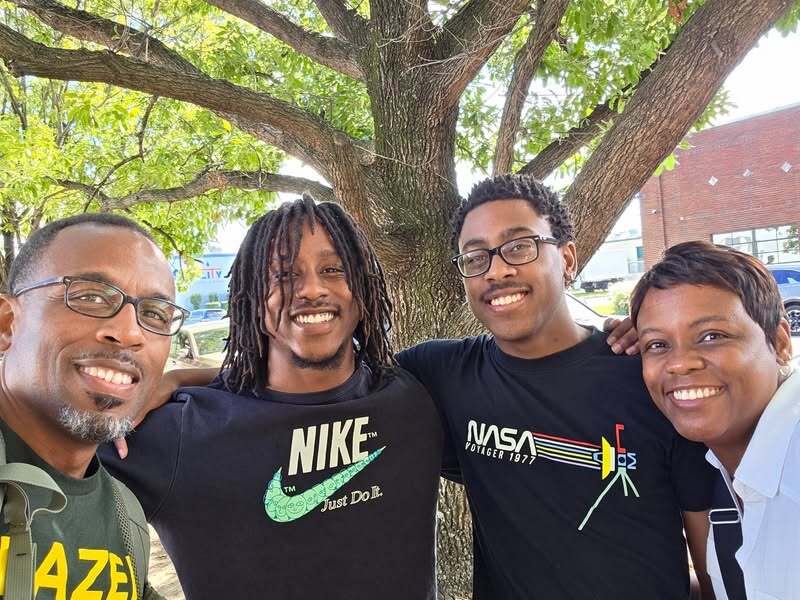
I arrived at that apartment a single man and left with this beautiful family.
As I look ahead to the second half of my life on this birthday, and again reflect on where God has brought me from, I have great hope—that I can start again, that I can build from here.